HLS design & implementation
End-to-end block design in C++: architecture, coding for hardware, constraint tuning, and RTL generation targeting your ASIC process or FPGA family.
An independent High-Level Synthesis consultancy for ASIC and FPGA teams. We take algorithms from concept to verified RTL through C++ design, architecture exploration, and a disciplined verification flow.
High-Level Synthesis lets a senior team work at algorithm and architecture level while retaining control of interfaces, memories, throughput, latency, and target technology. We build and verify the design in C++, then generate RTL for the downstream ASIC or FPGA flow.
End-to-end block design in C++: architecture, coding for hardware, constraint tuning, and RTL generation targeting your ASIC process or FPGA family.
We turn compute-heavy algorithms — DSP, imaging, communications, crypto — into pipelined, parallel hardware with the throughput and latency your system needs.
Bringing HLS into your organisation: flow setup, coding guidelines, verification strategy, and hands-on mentoring for your RTL and software engineers.
Self-checking C++ testbenches with reference-model comparison and coverage, plus the co-simulation and sign-off evidence that makes an HLS design defensible.
Suitable legacy Verilog or VHDL blocks re-architected as maintainable C++ HLS designs, preserving the agreed behaviour and interfaces.
Not sure HLS fits the block? Bounded experiments gather the evidence for a go, refine, or stop decision before you commit to implementation.
The output is still RTL for your normal ASIC or FPGA flow. What changes is where the design effort goes, and how many architectures you can afford to evaluate.
The functional model is usually more concise than its cycle-level RTL implementation, allowing many algorithmic bugs to be caught before RTL generation.
Native C++ tests support rapid functional iteration; generated RTL is then checked with co-simulation and the normal sign-off flow.
Latency, throughput, and area trade-offs become tool constraints — evaluate multiple microarchitectures from one source instead of committing to one up front.
A well-structured model can be re-synthesised for different targets, with the libraries, interfaces, constraints, and optimisation revisited for each one.
Four stages, each with explicit inputs and acceptance evidence, so decisions are made on results rather than estimates.
We start from your reference model, spec, or research code, and agree on interfaces, performance targets, and the verification plan.
The design is written as synthesisable C++ with bit-accurate data types, validated continuously against the reference model.
HLS constraints drive pipelining, unrolling, and memory architecture until timing, area, and power meet the target technology's requirements.
Generated RTL is verified against the C++ model and handed over with everything needed for your synthesis, place-and-route, and SoC integration flow.
Source, constraints, tests, generated RTL, reports, and integration documentation are kept together, so another engineer can review and rerun the work.
src/Synthesisable C++ design sourceconstraints/HLS and synthesis constraintstb/Self-checking testbenches and regressionsrtl/Generated, verified RTLreports/Synthesis reports covering timing and areadocs/Integration documentationUse these practical guides to assess fit, plan verification, and modernise an existing block without hiding the engineering trade-offs.
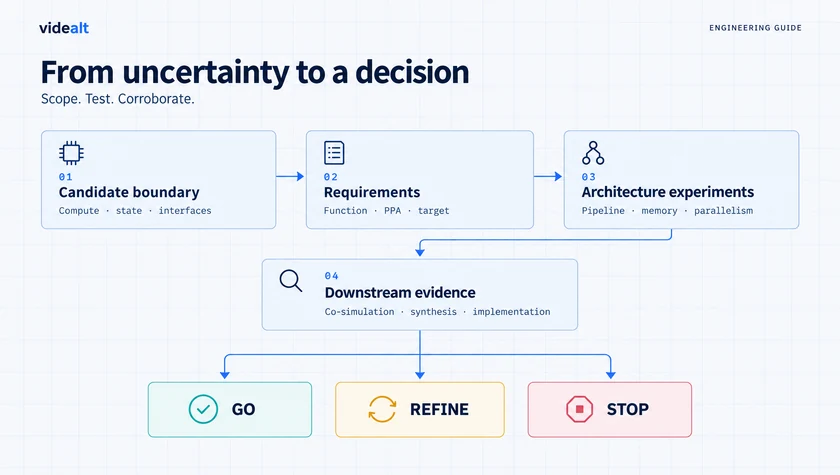
Define the inputs, experiments, acceptance criteria, and downstream evidence for a decision-grade feasibility study.
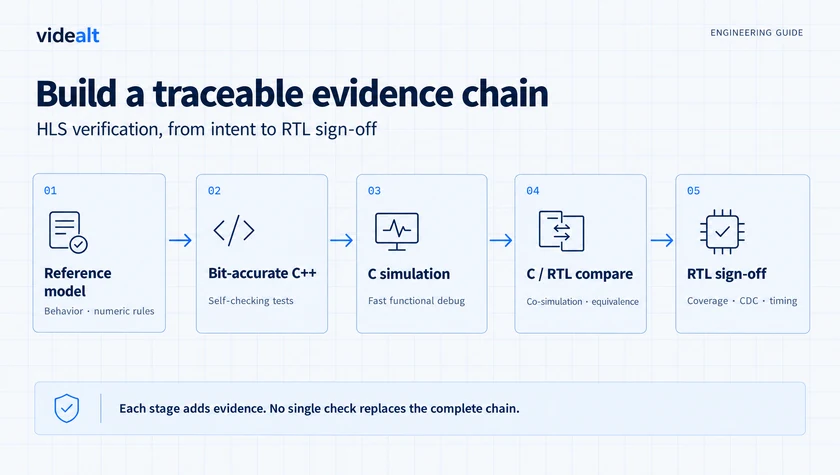
Build a layered flow from reference-model comparison and C++ tests through co-simulation and RTL sign-off.
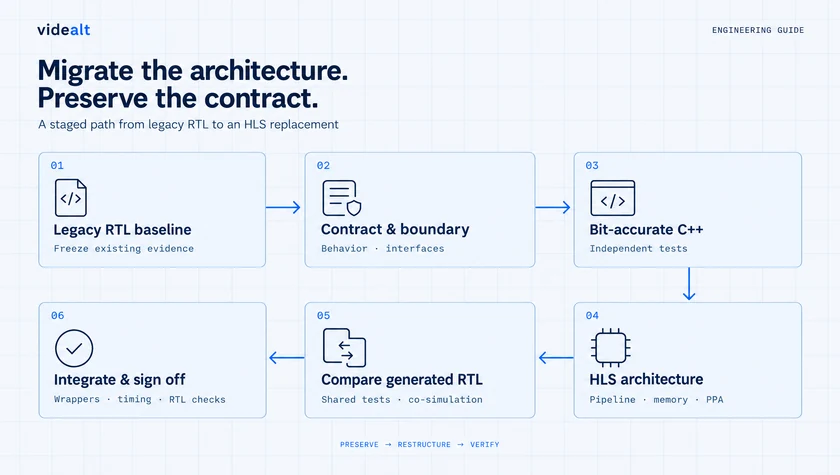
Preserve behaviour and interfaces while deciding which datapaths to migrate and which logic should remain in RTL.
Direct answers to the questions teams ask first. The services FAQ covers confidentiality, IP ownership, and tool licences.
High-Level Synthesis is a hardware design methodology in which digital circuits are described in a high-level language, typically C++ or SystemC, and automatically compiled into register-transfer level (RTL) code. The generated RTL then goes through the normal logic synthesis and place-and-route flow for an ASIC or FPGA.
Videalt is an independent High-Level Synthesis consultancy. We design ASIC and FPGA logic in C++ and SystemC, taking algorithms from concept through architecture, implementation, and verification to integration-ready RTL.
Yes. HLS supports both ASIC and FPGA development. The target libraries, memories, interfaces, timing constraints, and downstream flow differ, so each design is synthesised and evaluated for its intended technology.
HLS delivers the biggest advantage on algorithmic, datapath-dominated blocks such as digital signal processing, image and video processing, communications, cryptography, and AI/ML operators. Deeply control-oriented logic with cycle-exact protocol behaviour often remains better served by hand-written RTL, and a pragmatic project mixes both.
Synthesisable C++ source, HLS and synthesis constraints, self-checking testbenches, generated and verified RTL, synthesis reports, and integration documentation, kept together so another engineer can review and rerun the work. The exact list and acceptance evidence are agreed before work starts.
Usually with a short technical call, a design review, or a bounded HLS feasibility study. A few lines about the block, the target, and the decision you need to make are enough. A complete specification is not required, and confidentiality can be agreed before sensitive material is shared.
Tell us about your block, target, and constraints.